Series summary
What do we actually mean by a security system?
Equipment alone is not a security system.
Video surveillance, access control, analytics, and alarm systems can all operate in the same environment and still remain separate technological islands.
We tend to describe security in terms of components: the number of cameras, controlled doors, archive retention, and operator workstations.
For a small site, that may sometimes be enough. But real incidents rarely stay within the boundaries of a single subsystem.
A vehicle enters the site.
A camera recognizes the license plate.
The access control system allows entry.
Later, a sensor is triggered in a nearby zone.
The operator pulls up the video.
The shift supervisor makes a decision.
The next day, someone needs to reconstruct the sequence of events.
For a person, this is one situation. For the infrastructure, it is several systems, several logs, and a person who has to piece the whole picture together manually.
This is where the central question emerges: does an event retain its context as it moves through the security architecture?
That is the question that leads us to Genetec Security Center.
A Common Interface Does Not Make a Unified System
You can bring several subsystems into a single interface. That makes the operator’s job easier, but it does not mean those subsystems are operating as one system.
A unified architecture begins when cameras, doors, zones, vehicles, users, and alarms can exist within the same operational context, and an event from one subsystem becomes meaningful information for another.
Саме цю різницю ми окремо розбирали в матеріалі про архітектуру Security Center.
Part 1Genetec Security Center: How a Unified Security Architecture Works
But seeing the event is only the first step.
Context Has to Outlive the Event
Security systems are often designed around the moment an alarm is triggered.
What will the operator see? Which camera will come up? Who will be notified?
A more important question is: what will remain of that situation a month later?
Not just a video file, but the connection between the location, the time, the person, the vehicle, the access right, and the actions that followed the event.
Thirty days of archive retention is a storage specification. The ability to reconstruct the full picture quickly is an architectural capability.
We explored this in more detail in our article on working with video after an incident.
Part 2How Genetec’s Unified Architecture Changes Post-Incident Video Investigations
Correct Operation Does Not Necessarily Mean the Right Decision
Physical access provides a clear example of the difference between equipment and a system.
The door opened. Technically, everything worked as intended.
The more important question is: why does this person still have access to this area?
In a mature architecture, what matters is not only the fact that access was granted, but the lifecycle of the decision behind it: who received access, on what basis, for how long, and what should happen when that basis no longer applies.
We explored how this layer works through Synergis and ClearID in a separate article.
Part 3Genetec Synergis and ClearID: Managing the Physical Access Lifecycle
Detecting an Event Is Not Enough
A sensor is triggered. The system records the event. That answers one question: what happened?
What defines the organization is the next question: what do we do now?
If the answer exists only in the memory of an experienced operator, then response has not yet become a system.
A managed process begins when you can see not only the incident itself, but also the sequence of actions, who was responsible, the deadlines involved, any deviations from procedure, and why those deviations occurred.
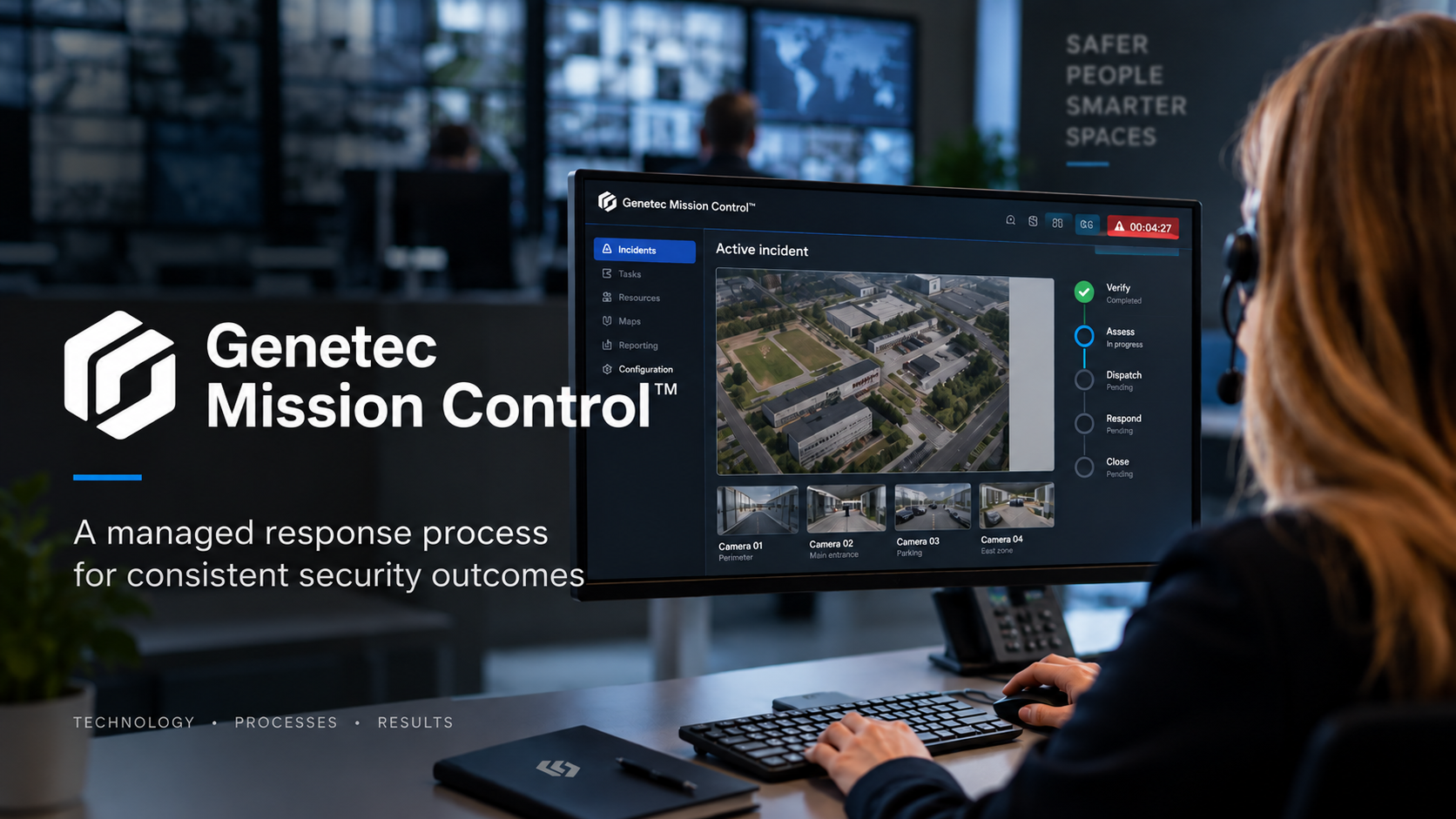
That is the level we explored in our article on Mission Control.
Part 4Genetec Mission Control and Managed Incident Response
Video Can Be More Than an Image
Another important distinction is between recording and data. If a camera only stores video, someone still has to review that footage later.
If the system extracts structured attributes from the event — a license plate, time, location, object characteristics — those attributes can be used differently: searched, correlated, and passed on to the next process.
Images have to be reviewed. Data can be queried.
We explored this transition through AutoVu and analytics events in a separate article.
Part 5When Video Becomes Data: What Changes for the Security Team
Real Architecture Reveals Itself Over Time
On the day a system is commissioned, almost everything can look convincing: cameras are recording, doors are opening, and alarms are reaching the operator. The harder questions emerge years later. New versions appear, equipment changes, new integrations are added, and cybersecurity requirements evolve.
At that point, the key measure is no longer the number of features, but the predictability of change: what a change will affect, and what will need to be revalidated afterward.
A good architecture allows the system to evolve without having to be rebuilt from the ground up each time.
That was the focus of the sixth article in this series.
Part 6How Will Genetec Security Center Hold Up After Five Years in Operation?
Now Let’s Scale Up
So far, we have been looking at a single site.
Now the problem becomes more interesting.
Imagine a large industrial complex: multiple buildings, a secured perimeter, vehicle traffic, thousands of users, its own video surveillance system, access control, analytics, and building systems. Different teams are responsible for different parts of this environment, with different levels of authority.
This is a complex site.
Now distribute sites like this across the city.
Add transportation infrastructure, public utilities, universities, hospitals, government buildings, and private businesses.
Each of them may have its own system, its own owner, its own rules for data access, and its own area of responsibility.
A city becomes a complex system not because everything in it needs to be connected to a single server. Quite the opposite.
At this scale, individual systems can remain autonomous, while a shared operational picture is created only where it is needed.
This is how real-world Genetec city deployments are structured: different VMS, GIS, CAD, ALPR, IoT, transportation, and private systems can continue performing their own functions, while the operations center receives the context needed for a specific incident. In this model, Safe City is not “one large system,” but a managed environment of integrated systems.
This model is already in use, in different forms, across urban operations centers — from Albuquerque and New Orleans to Edinburgh and Chicago. In some cases, the primary objective has been a shared operational picture; in others, federation across independent organizations, evidence management, or coordination between city services.
And this leads to an important principle:
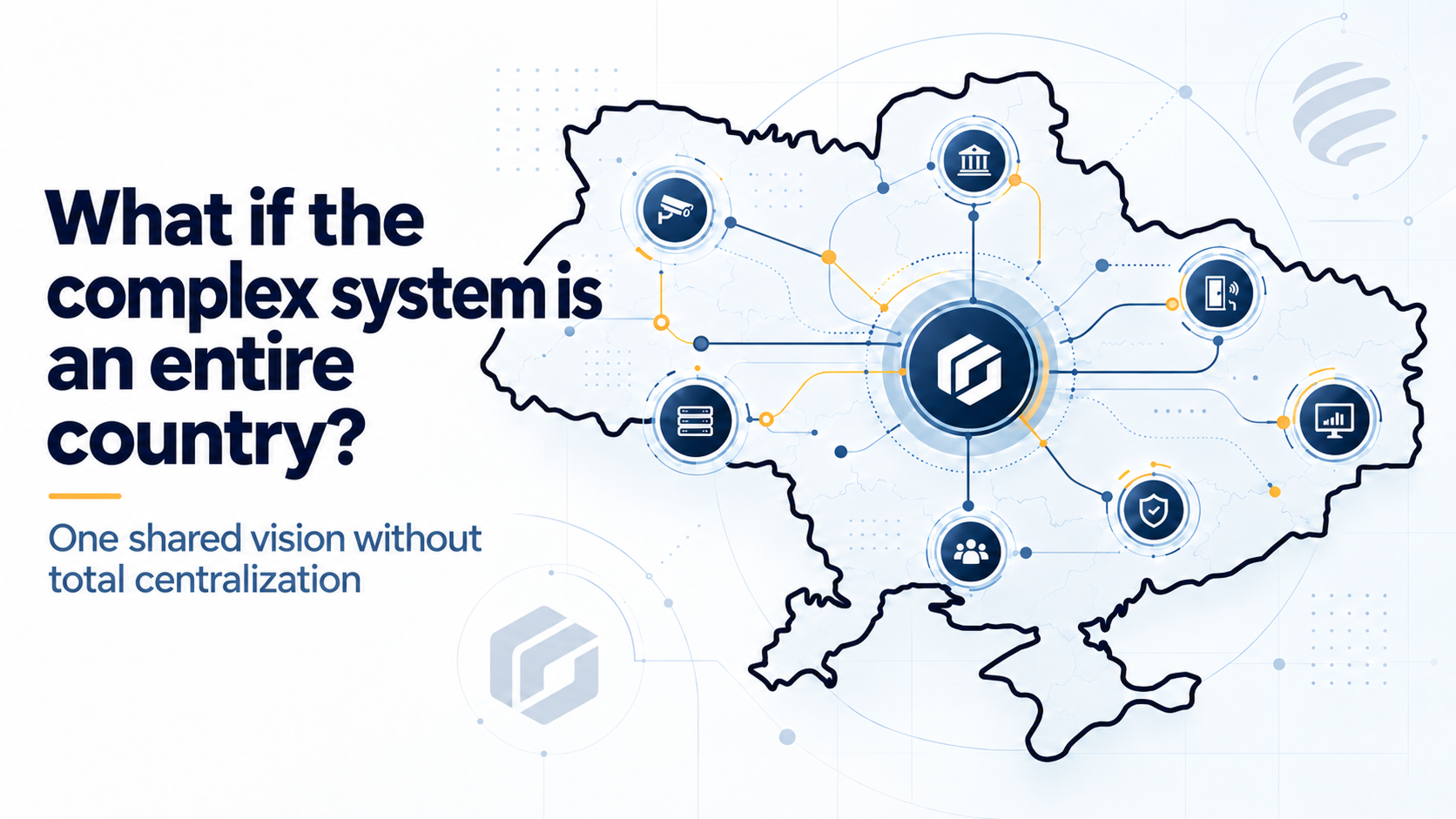
What If the Complex System Is a Country?
Let’s scale up once more.
A city, a region, transportation corridors, critical infrastructure, government institutions, industrial facilities, and private sites — all of them are systems that already exist and belong to different organizations.
Systems that already exist and belong to different organizations.
At a certain scale, a country can also be viewed as a system of complex systems. Not as one enormous Security Center deployment. And not as an attempt to build a single center that “sees everything.”
That would be too simplistic a way to think about scale.
The architectural challenge now is to determine which data should remain local, what should be available at the city or regional level, and what context one organization should be able to share with another.
При цьому потрібно зберегти межі відповідальності: хто лише бачить подію, хто може діяти і як підключити новий об’єкт, не перебудовуючи всю систему.
At the same time, the boundaries of responsibility need to remain clear: who can only see an event, who is authorized to act, and how a new site can be brought into the architecture without redesigning the entire system.
Not because the platform needs to replace every other system, but because its architectural logic allows it to operate in an environment where many such systems already exist.
It is at larger scale that this architectural logic becomes most valuable.
The Scale Changes. The Architectural Questions Do Not.
- At a small site, the question is: what happened at this door?
- At a city operations center, the question becomes: what is happening in this part of the city right now, and which systems can provide the context?
- At the level of a network of sites, the question is: which data needs to be connected, and which should remain with its respective owners?
The scale changes. The logic does not.
An event needs to be seen, understood in context, checked against access rights, acted on, and preserved in a form that remains useful afterward.
That is why Genetec Security Center is better evaluated not by the number of features it offers — or even by the number of products in its ecosystem.
The more important question is:
How far can this architecture scale without turning a complex environment into a single technological monolith?
- For a single site, it is a question of integration.
- For a city, it is a question of coordination.
- For a country, it is a question of interaction between autonomous systems.
And perhaps this is the question every large-scale security project should begin with:
Not “What equipment do we need?” but “What picture of an event does our architecture need to preserve — and at what scale?”